How long does Google take to index a page?
Google's Gary Illyes showed how long Google usually takes to find, index and update pages, and how long the slow cases take. Here are the figures and what they mean in practice.

By Matt Hodson ·
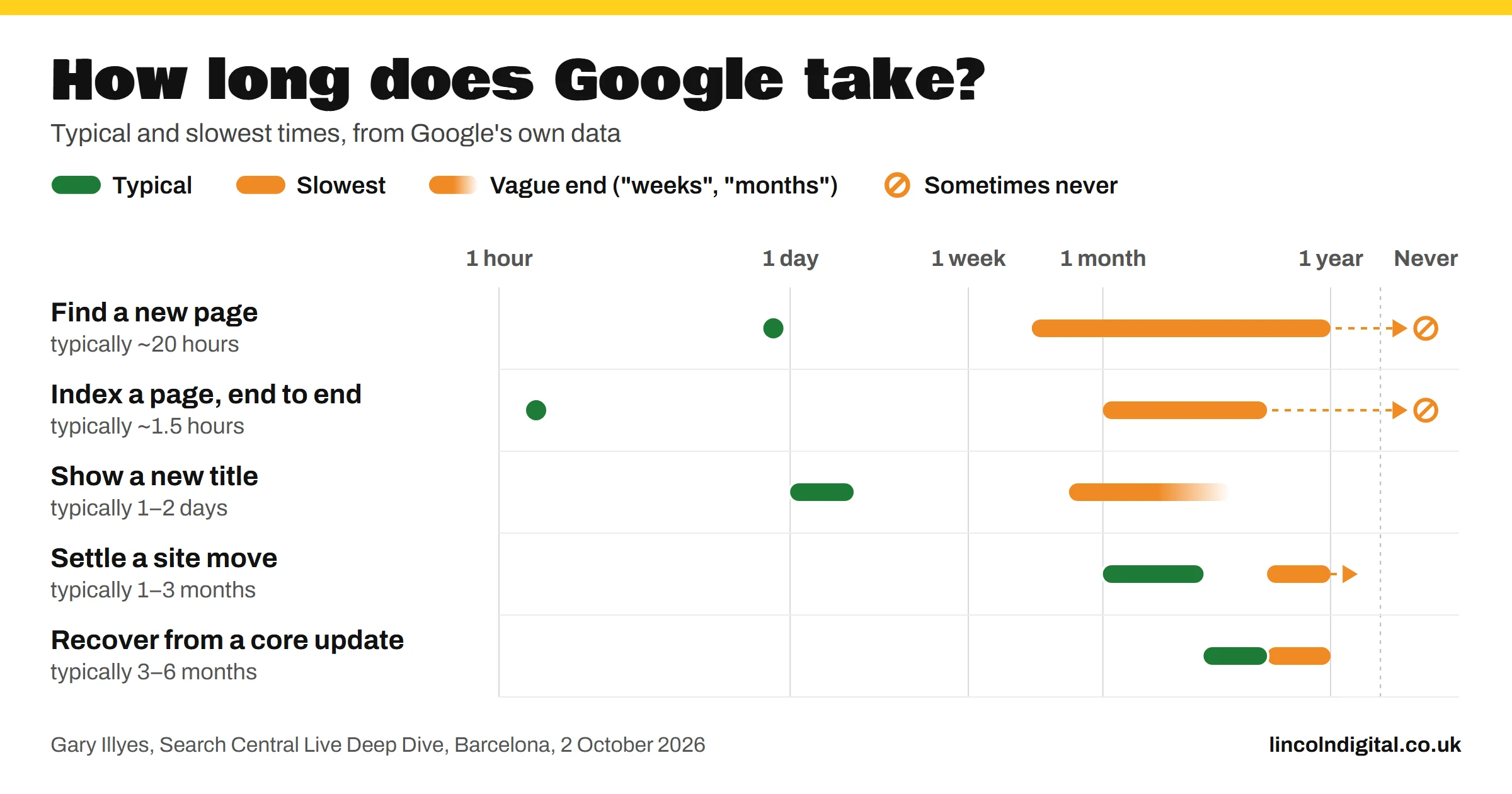
Google has put some numbers on how long things take.
At Search Central Live in Barcelona on 2 October, Gary Illyes from Google's Search team gave a talk called "How long does it take to…?". He showed typical and slowest times for crawling, indexing and changes showing up in search, taken from Google's own data.
Google hasn't published the slides. The figures below come from John Campbell's write-up for ROAST, and Search Engine Roundtable has photos of the slides. Google didn't say what "typical" means or how it was measured, so they're a rough guide.
The main numbers
- A new page gets found in about 20 hours.
- Indexing takes about an hour and a half once Google gets to the page.
- Pages Google already knows about get crawled again roughly every 30 days.
- A new title or snippet shows up in a day or two.
- A site move takes one to three months to settle.
- Recovering from a core update takes three to six months.
The slow cases are a lot slower. Finding a page, crawling it again and indexing it can all take "never". For indexing, Google put that down to quality.
All the figures
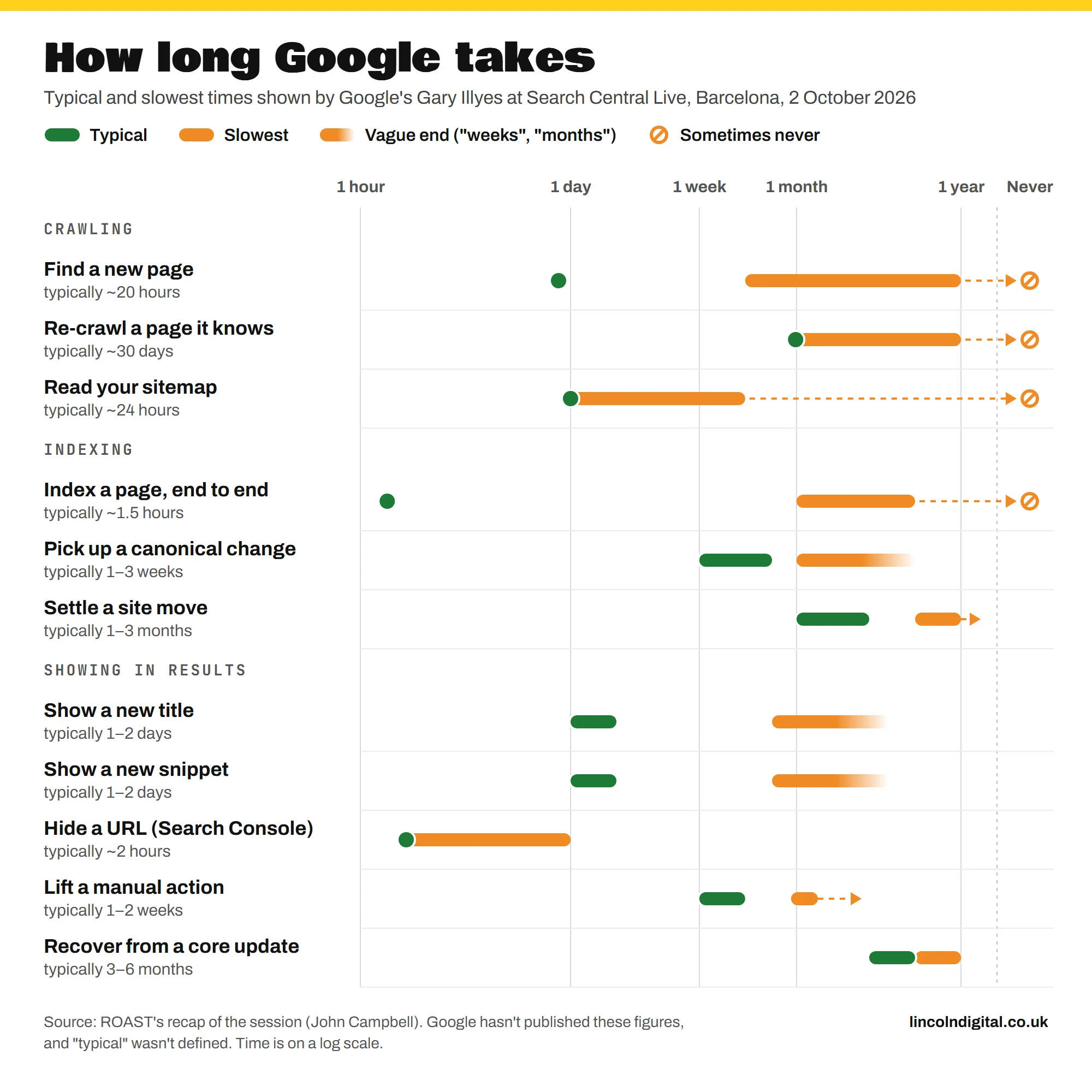
| What Google is doing | Typical | Slowest |
|---|---|---|
| Crawling | ||
| Finding a new URL | About 20 hours | Weeks to never |
| Crawling a URL it already knows again | About 30 days | Weeks to never |
| Reading a sitemap | About 24 hours | Up to 14 days, or never (quality) |
| Indexing | ||
| Rendering a page | Seconds to render, hours in the queue | Days to weeks |
| Indexing a page, end to end | About 1.5 hours | Months, or never (quality) |
| Picking up a canonical change | 1 to 3 weeks | Months (conflicting signals) |
| Settling a site move | 1 to 3 months | 6 months to over a year |
| Showing in results | ||
| Showing a new title | 1 to 2 days | Several weeks to months |
| Showing a new snippet | 1 to 2 days | Several weeks to months |
| A removal by the site owner in Search Console | About 2 hours | 24 hours |
| Lifting a manual action | 1 to 2 weeks | 4 to 6 weeks, or much longer for dormant sites |
| Recovering from a core update | 3 to 6 months | 6 months to a year (the next core update) |
Why the slow cases are so slow
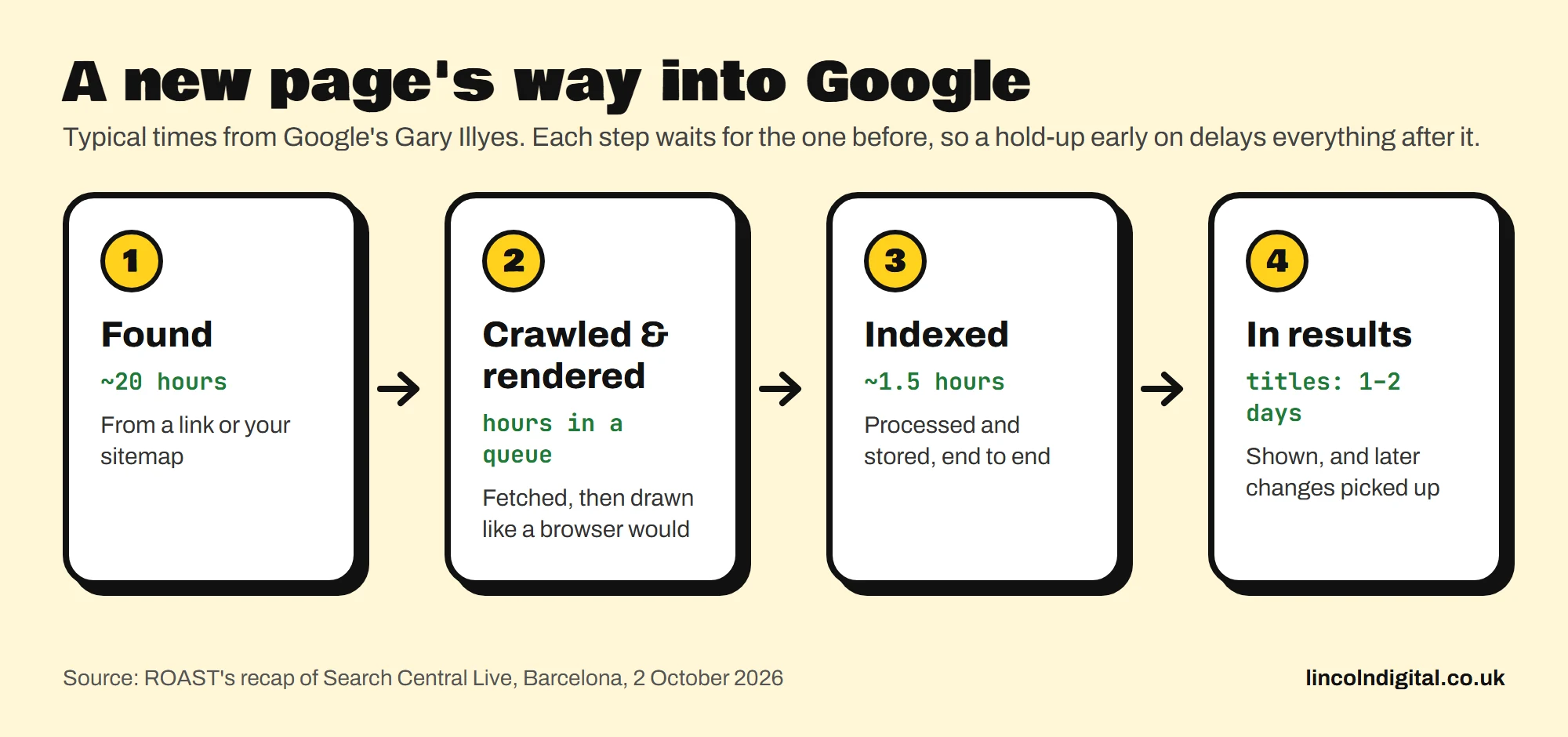
Each step has to wait for the one before. Google can't crawl a page it hasn't found, index a page it hasn't crawled, or show a title it hasn't indexed. Illyes made this point in the talk. If a page is slow to get found, everything after that is late too.
What this means in practice
New pages
Give a new page a couple of days before you start worrying. If it's not in Google the next morning, that's normal.
If it's still not there after two weeks, it's more likely to be a quality problem than a speed one. Google won't index a page it doesn't think is worth indexing, and asking again won't change that. Improving the page might.
If the page is worth indexing, you can speed it up. Link to it from pages Google visits a lot, and keep your sitemap up to date, as Google usually reads it within a day. For important pages, use "Request indexing" in Search Console's URL Inspection tool.
Changes to existing pages
Google usually gets round to a page it already knows about once a month or so. A new title can show within a day or two, but only after Google has crawled the page again. On a page that doesn't get crawled often, that can take weeks. Linking to it from a new page or requesting indexing can speed it up.
Canonical changes
These usually take one to three weeks. The ones that take months are down to conflicting signals, according to Google. If you change which URL is the main one, make sure your redirects, canonical tags, internal links and sitemap all agree. Google's guide to fixing canonicalisation issues explains what it checks.
Site moves
One to three months is typical, and it can go past a year. After moving domain or platform, expect rankings to move around for a few months, and keep the redirects in place permanently. I wouldn't judge a move on its first few weeks. Google's site move guide is the checklist I'd follow, and it's what our redesigns and migrations are based on.
Removals and manual actions
The Removals tool in Search Console is quick: usually about two hours, and within a day at worst. It only hides a page for about six months, so delete the page or add a noindex tag as well.
Manual actions take longer to lift. It's usually one to two weeks, up to four to six weeks, and longer still for sites that aren't active.
Core updates
Recovery usually takes three to six months, and can take up to a year, which often means waiting for the next core update. Google's guidance on core updates says the same: improvements can take months to show. If a core update hit your traffic, work on making the content better and give it a few months before deciding whether it's worked.
Sources
- Google Search Central Live Deep Dive, Barcelona: day 3 recap, John Campbell for ROAST, 2 October 2026
- Google: How long it takes Google Search for crawling, indexing and serving, Barry Schwartz for Search Engine Roundtable, 5 October 2026, with photos of the slides
- Search Central Live Deep Dive Europe 2026, Google's announcement of the event
I also keep an eye on Google's documentation with our free search change tracker, which shows every change to it word for word. If Google ever adds these timings to its docs, they'll show up there.