moderate change What the guidance says has shifted
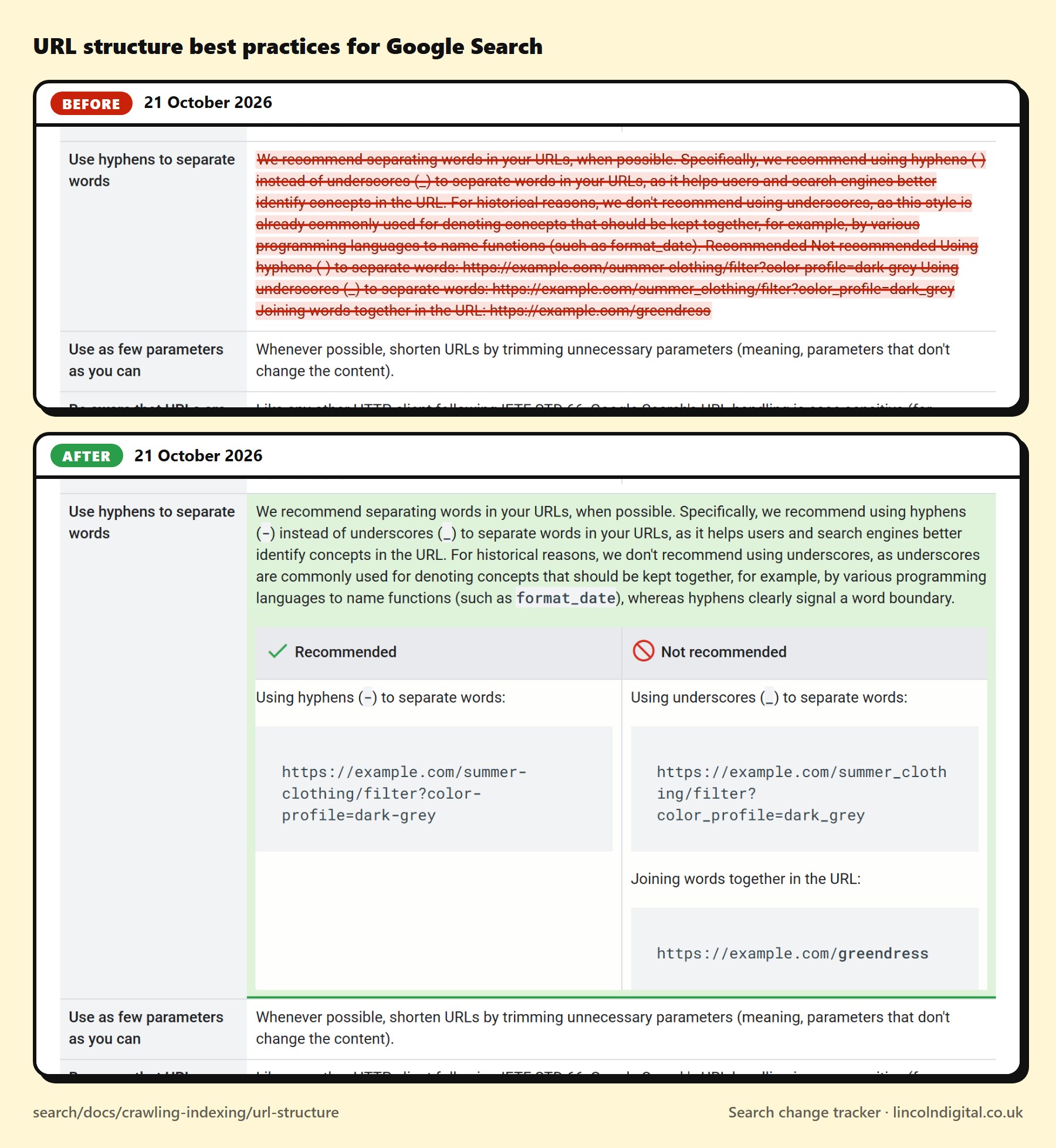
Google rewrote the explanation for not recommending underscores in URLs, changing 'this style is already commonly used' to 'underscores are commonly used' and adding that hyphens clearly signal a word boundary.
Lincoln Digital's AI Overview
The guidance still recommends hyphens over underscores, so the practical advice is unchanged. The added explanation could help site owners and SEOs understand why hyphens are preferred, but it does not impose any new requirement.
Generated by AI from the change below: a guide to what it could mean, not a certainty.
Word for word
red was taken outgreen was put in
In “Make it easy to understand your URL structure”
Use hyphens to separate words | We recommend separating words in your URLs, when possible. Specifically, we recommend using hyphens (-) instead of underscores (_) to separate words in your URLs, as it helps users and search engines better identify concepts in the URL. For historical reasons, we don't recommend using underscores, as [removed: this style is already ][added: underscores are ]commonly used for denoting concepts that should be kept together, for example, by various programming languages to name functions (such as format_date)[added: , whereas hyphens clearly signal a word boundary]. Recommended Not recommended Using hyphens (-) to separate words: https://example.com/summer-clothing/filter?color-profile=dark-grey Using underscores (_) to separate words: https://example.com/summer_clothing/filter?color_profile=dark_grey Joining words together in the URL: https://example.com/greendress
On Google's page
The "before" is the same page with the earlier wording put back.
Changed between our checks at and (UK time)Google's “last updated” date moved from 10 Dec 2025 to 21 Oct 2026Posted on X Link to this change